
I was doing some competitive research recently — something I do regularly to stay sharp after 30 years in this business — and I stumbled across a web design company’s site that caught my attention.
Not because they were doing something impressive. Because they were doing something I’ve seen before, and I knew exactly how it was going to end.
I’m not going to name them. That’s not the point. The point is what they did, why Google eventually crushed them for it, and why the same thing won’t happen to any business that works with me.
What they were doing
This web design company had created dozens — maybe hundreds — of location pages. Pages like “Web Design in [City], [State]” for cities all over the country. Midland, Michigan. Branson, Missouri. Shively, Kentucky. Lake Worth Beach, Florida.
Cities they almost certainly had never worked in. Cities they had no connection to whatsoever.
Every page was the same template with a city name swapped in. Same copy. Same layout. Same everything — just a different location dropped into the headline.
On top of that, they had built a massive backlink profile. At their peak, over 36,000 backlinks were pointing to the site. That’s a lot of links — and in the SEO world, links used to be (and still are, to a degree) a signal of authority.
The strategy had a name in SEO circles: programmatic SEO. Generate hundreds of pages at scale, target low-competition local keywords, get those pages ranking, pull in traffic. It sounds clever. It worked — for a while.
It actually worked — until it didn’t
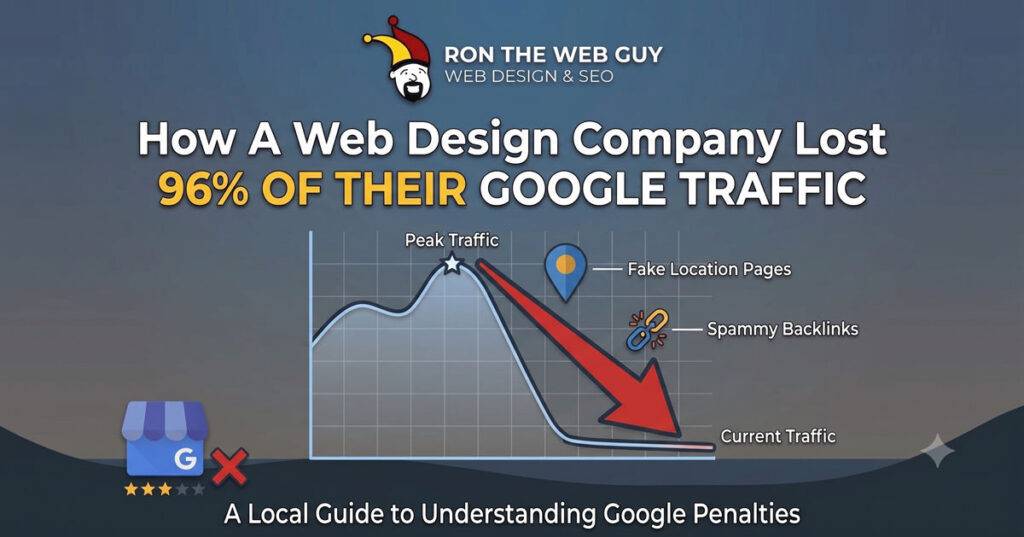
I’ll give credit where it’s due: the tactic produced real results, temporarily. Their organic traffic peaked at over 1,600 visitors per month. For a small web design practice, that’s meaningful.
But Google wasn’t done evaluating.
In late 2025, something shifted. Google began devaluing their link profile. Their domain authority — a measure of how much Google trusts the site based on its backlinks — dropped from 43 to 34 in just two months. Nine points. Gone.
Traffic briefly held on. January 2026 was actually one of their best months. Then the floor dropped out.
February. March. April. Month after month the traffic collapsed. By July 2026, they were sitting at fewer than 60 monthly organic visitors. Down from 1,600+.
That’s a 96% loss.
Of those 36,000 backlinks? Only about 3,500 are still live. Google effectively wrote off the other 90% as worthless — or worse, as a signal that something was wrong with this site.
Why Google did this
Google has been getting better and better at one thing: distinguishing between content that actually helps people and content that exists purely to game rankings.
A page that says “Web Design in Branson, Missouri” written by someone who has never been to Branson, serving clients who don’t exist there, targeting a keyword nobody is actually searching — that is not helpful content. That’s filler designed to trick a search engine.
Google’s algorithm updates over the past two years have specifically targeted what they call “scaled content abuse” — the practice of generating large volumes of templated, low-quality pages to capture search traffic. It doesn’t matter if the template is filled in by a human or an AI. If the content exists to rank rather than to help, Google is increasingly catching it.
The backlink situation makes it worse. When you build links at scale — buying them, trading them, generating them through link farms — Google eventually figures it out. When they do, they don’t just stop counting those links. They may count them against you.
This company’s site went from a competitive player to basically invisible. In six months.
30 years tells me: there are no shortcuts
I started building websites in 1996. I’ve watched search engines evolve from AltaVista and Yahoo to Google’s current AI-driven algorithms. I’ve watched tactics rise and fall. And I can tell you — every single shortcut I’ve ever seen work eventually stops working.
Keyword stuffing. Invisible text. Paid links. Article spinning. Fake reviews. Private blog networks. Doorway pages. The list of “clever” tactics that Google has methodically hunted down and penalized is longer than most people realize.
Programmatic location pages are just the current version. They work until they don’t, and when they stop working, they stop fast.
Here’s what doesn’t get penalized: a real business, with a real service area, producing real content that answers real questions from real people.
That’s it. That’s the whole strategy. It’s less exciting than “hack Google with 500 fake location pages,” but it’s the one that still works five years from now.
What I do differently
When I build a page for your business, it’s about your business. Your actual location. Your actual services. Your actual customers. I’m not generating 200 versions of the same page for cities I’ve never heard of.
When I build links, it’s through legitimate means — local directories, real citations, content that other sites actually want to link to because it’s useful.
When I do SEO, I’m working within Google’s guidelines — not around them. Not because I can’t figure out the shortcuts, but because I’ve been doing this long enough to know exactly what happens when those shortcuts expire.
The same thinking applies to who builds your site. Global freelance platforms come with their own set of risks worth understanding before you hand someone the keys to your web presence.
The web design company in this case study is going to have to start over. They’ll need to audit every page, clean up their backlink profile, and rebuild their content from scratch — if they can recover at all. Meanwhile, their phone isn’t ringing from Google.
That is never going to be a conversation you and I have.
Want results that actually last?
If you’re a small business owner in Kittitas County — Cle Elum, Ellensburg, Roslyn, or anywhere in the area — and you want to show up in Google without worrying that the whole thing is going to collapse six months from now, let’s talk.
I’ve been doing this for 30 years. I know what Google rewards. I know what Google punishes. And I’m not going to put your business at risk chasing tactics that have an expiration date.
Ready to talk? Call/Text (425) 243-7239
Or book a free 15-minute consultation via ZOOM.
Ron the Web Guy has been building and managing websites for small businesses in Washington state since 1996. Based in Roslyn, WA — serving Cle Elum, Ellensburg, Wenatchee, and all of Kittitas County.
Services: Web Design | Web Hosting | SEO | Website Clean-Up