
I’ve been building websites and helping businesses understand technology for decades.
Lately, like many business owners and marketers, I’ve been spending time with AI assistants such as Microsoft Copilot and Claude. The more I use them, the more I’ve realized something:
The AI industry has a messaging problem.
And I think they’re explaining AI backwards.
If You’re Confused, It’s Not You
Over the past year, I’ve talked with business owners who want to understand AI.
Some have tried Microsoft Copilot.
Some have tried Claude.
Some have tried ChatGPT.
Some have tried Gemini.
Almost all of them eventually ask a version of the same question:
“What’s the difference between all these AI things?”
It’s a reasonable question.
Unfortunately, the answers often sound like a graduate-level computer science lecture.
The AI industry starts talking about:
- Models
- Context windows
- Reasoning capabilities
- Benchmarks
- Neural networks
Meanwhile, the business owner is just trying to figure out:
“Can this help me write better blog posts?”
The Moment It Finally Clicked
Recently, while comparing Microsoft Copilot and Claude, I found myself going down the same rabbit hole.
AI assistants.
AI models.
Copilots.
Chatbots.
Coding tools.
Agentic workflows.
The deeper I dug, the more confusing it became.
Then I realized something.
The industry keeps leading with AI models.
But customers don’t buy AI models.
They buy AI assistants.
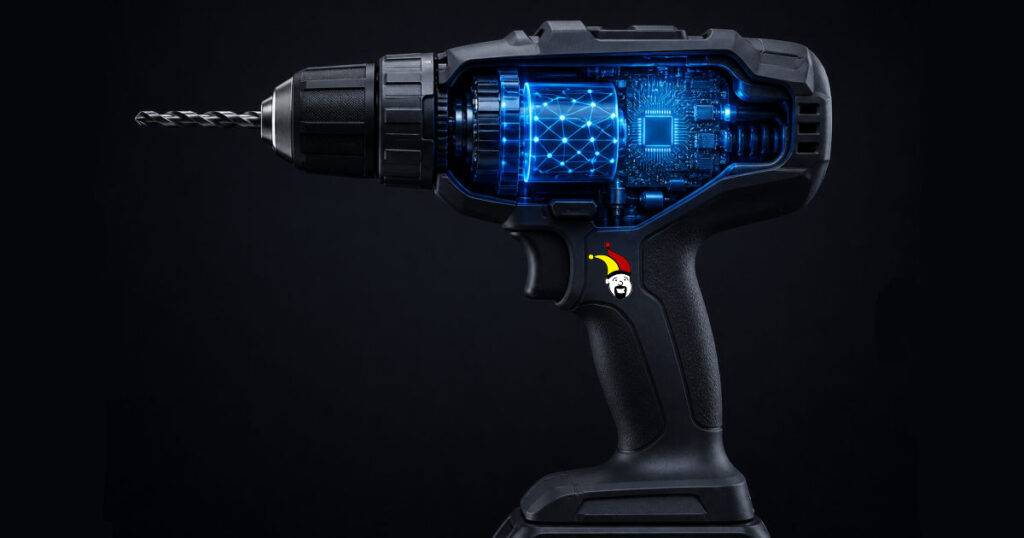
That’s when the power tool analogy finally clicked.
The Simple Explanation
Microsoft Copilot, Claude, ChatGPT, and Gemini are AI assistants.
Think of them as power tools.
The AI model is the motor inside the power tool.
The motor provides intelligence.
The power tool helps you get work done.
Most people don’t walk into a hardware store asking:
“Which motor should I buy?”
They ask:
“What’s the best tool for this job?”
The motor matters.
But the tool matters more.
Why AI Companies Are Making This Hard
I think the AI industry is marketing to engineers while trying to sell to business owners.
Engineers naturally care about the motor.
Business owners care about getting work done.
An engineer might ask:
“Which AI model is best?”
A business owner asks:
“Which AI assistant can help me write content, answer customer questions, save time, and grow my business?”
Those are completely different conversations.
Yet most AI marketing starts with the engineer’s question.
That’s why so many people are confused.
Nobody Cares About the Motor First
Imagine buying a power drill.
The salesperson says:
“This drill contains an advanced motor capable of impressive performance metrics.”
You’d probably stare at them and say:
“Can it help me build my deck?”
That’s exactly what’s happening in AI.
Businesses are being bombarded with discussions about models while trying to solve everyday problems.
They want help with:
- Marketing
- Customer service
- Content creation
- Research
- Productivity
- Website updates
They don’t wake up in the morning wondering which AI model has the highest benchmark score.
That’s also true of AI assistants. The model determines how smart the assistant is. But the assistant itself determines what it can actually access, connect to, and get done for you.
A Real-World Example
Let’s say you’re a business owner who wants to publish a new blog post.
One AI assistant can:
- Access your company documents
- Review meeting notes
- Analyze research
- Draft content
Another AI assistant can:
- Understand your website project
- Create new website files
- Update metadata
- Add structured content
- Prepare pages for publishing
Both may contain highly capable AI models.
But they’re helping with different parts of the process.
That’s why comparing AI assistants based solely on the model inside them often misses the point.
The real question is:
Which assistant helps me accomplish my goal?
The Question Businesses Should Be Asking
Instead of asking:
“What’s the best AI model?”
Try asking:
“What’s the best AI assistant for my workflow?”
That’s usually the more important question.
For example:
If your company lives in Outlook, Teams, SharePoint, Word, and Excel, Microsoft Copilot might be an excellent fit.
If your work revolves around content strategy, website development, technical documentation, or complex projects, another assistant may be a better fit.
The winner isn’t always the smartest assistant.
The winner is often the assistant that works where you already work.
What This Means for Small Businesses
I believe we’re still in the early days of AI adoption.
Right now, everyone seems to be comparing:
- Copilot vs. Claude
- Claude vs. ChatGPT
- GPT vs. Gemini
Eventually, I think those conversations become less important.
Most business owners don’t know what database powers their accounting software.
Most drivers don’t know what engine is inside their vehicle.
Likewise, I suspect most businesses won’t care which AI model powers their assistant.
They’ll care whether that assistant helps them:
- Save time
- Improve productivity
- Serve customers better
- Grow revenue
- Eliminate repetitive work
And honestly, that’s how it should be.
For a local business, this isn’t just a philosophical question. AI assistants are increasingly how your own customers find and evaluate businesses — not just by Googling, but by asking Copilot or ChatGPT directly. Whether your business shows up in those AI answers depends on choices most business owners have never had to think about before.
Final Thoughts
The biggest breakthrough I had wasn’t learning more about AI models.
It was realizing that the industry keeps talking about the motor when customers are trying to choose a power tool.
Once I stopped focusing on models and started focusing on assistants, the entire AI landscape became much easier to understand.
So if you’ve been confused by all the AI terminology lately, don’t feel bad.
You may not be struggling with AI.
You may simply be listening to an industry that’s explaining it backwards.
If you’re wondering whether your business is even visible to AI assistants right now, that’s worth checking. Reach out and I’ll take a look.